
(October 2026) UbiWell Lab at UbiComp 2026
Several UbiWell Lab members will be attending UbiComp/ISWC 2026 in Shanghai! We’re looking forward to a busy week of presenting our research, participating in workshops and the Doctoral Colloquium, leading a hands-on tutorial, and helping organize the Mental Health workshop.
continue reading...
UbiWell Lab
The Ubiquitous Computing for Health and Well-being (UbiWell) Lab is an interdisciplinary research group at the Khoury College of Computer Sciences and the Bouvé College of Health Sciences at Northeastern University.
We work on developing data-driven solutions to enable effective sensing and interventions for mental- and behavioral-health outcomes with mobile and ubiquitous technologies.
Research Areas
Our interdisciplinary team works at the intersection of mobile/wearable sensing, data science, human-centered computing, and behavioral science.
We work on exploring and advancing the complete "lifecycle" of mental- and behavioral-health sensing and intervention, which includes (a) accurately sensing and detecting a mental or behavioral health condition, like stress and opioid use; (b) after detecting a particular condition, determining the right time to deliver the intervention or support, such that the user is most likely to be receptive to the interventions provided; and (c) choosing the best intervention delivery mechanism and modality to ensure just-in-time delivery and reachability.
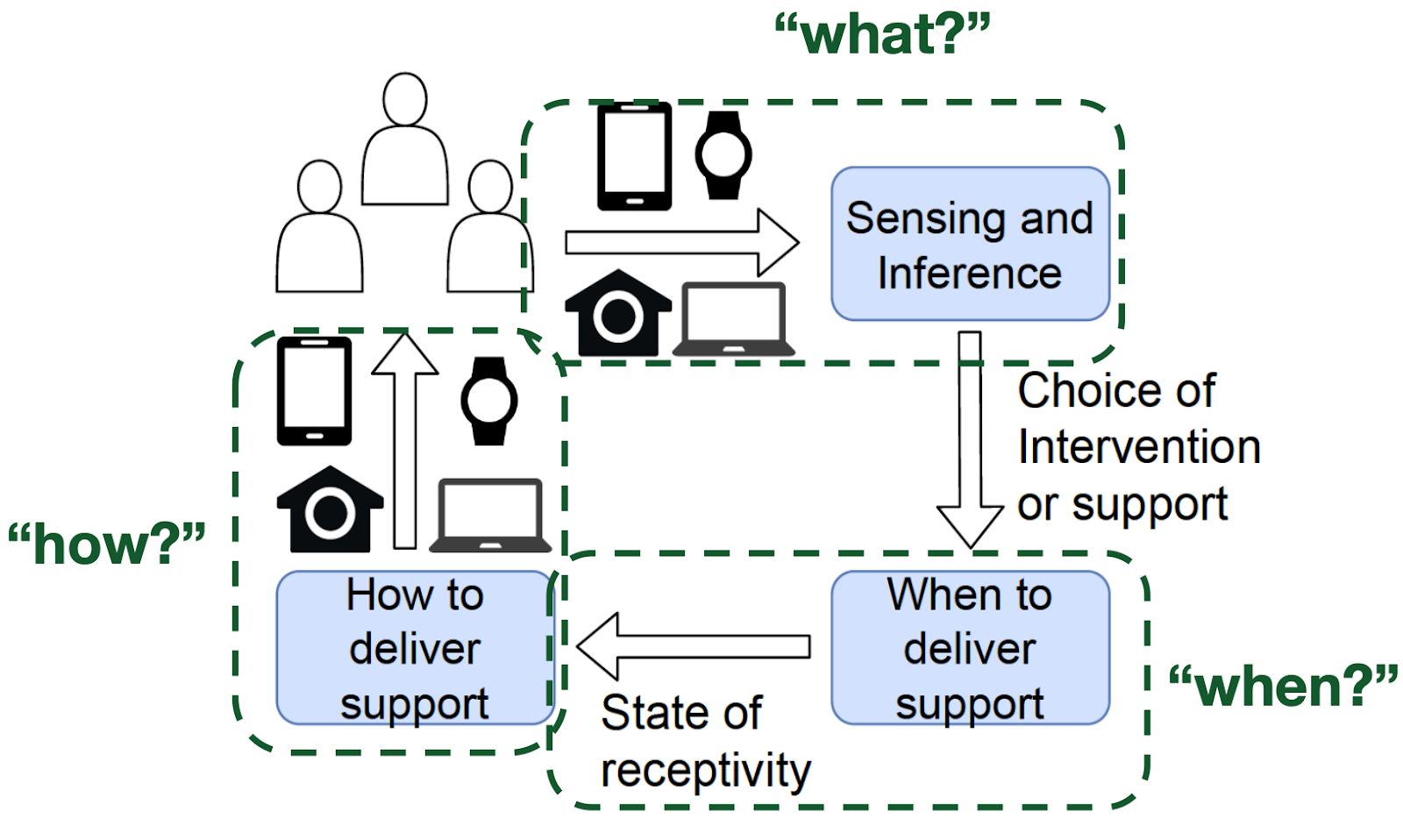
A simplified representation of the sensing to intervention lifecycle.
Current Projects
Causal modeling for physiological stress
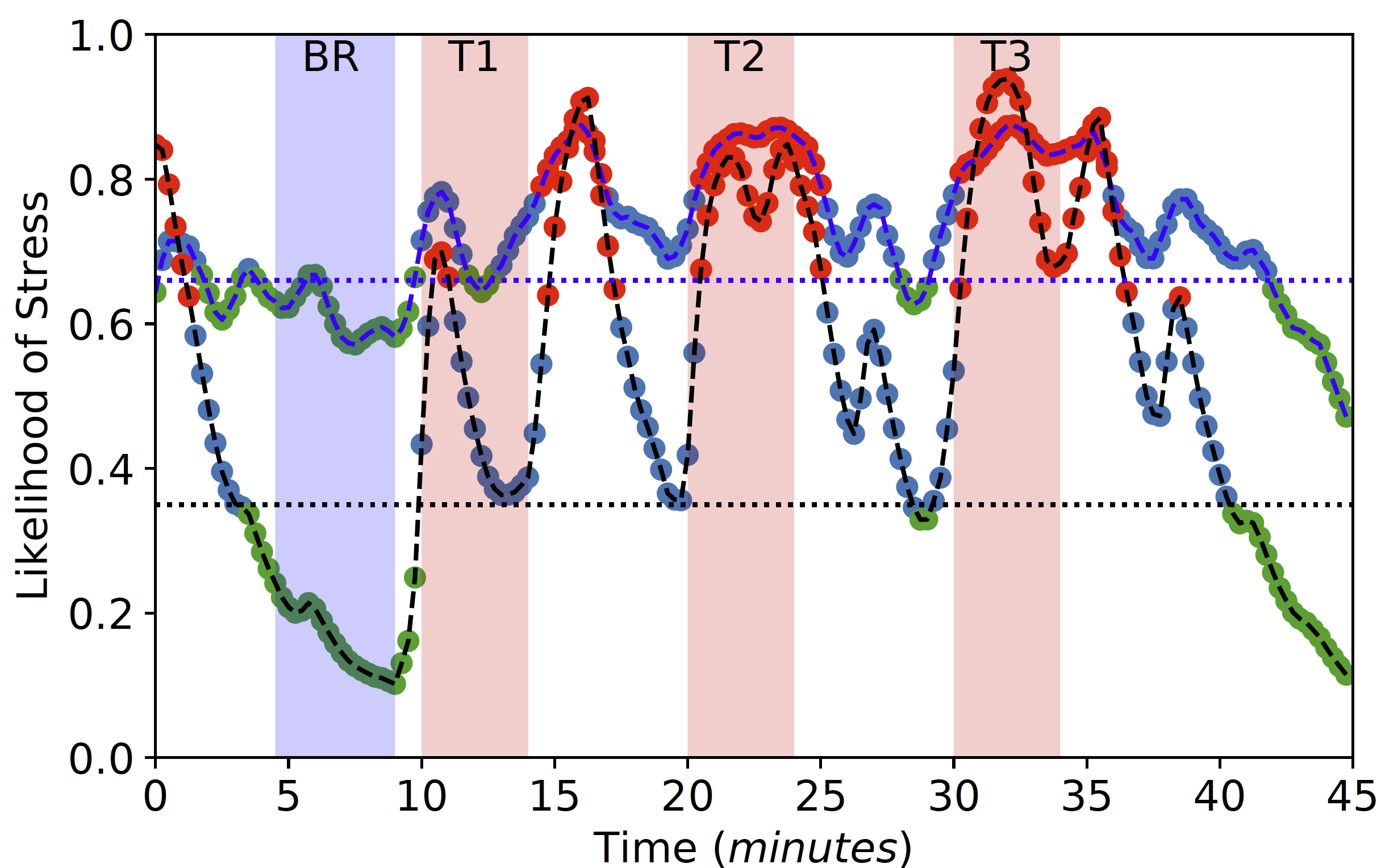
We are working on various projects to leverage multimodal data and understand the contextual and behavioral factors that lead to physiological stress, and evaluate its association with the perception of stress.
Predicting relapse during OUD treatment

We are working on a longitudinal study to detect at-risk indicators, e.g., stress, craving, and mood, among patients undergoing Opioid Use Disorder (OUD) treatment, using passively collected contextual and sensor data from smartphones and wearables.
States-of-receptivity for digital health interventions
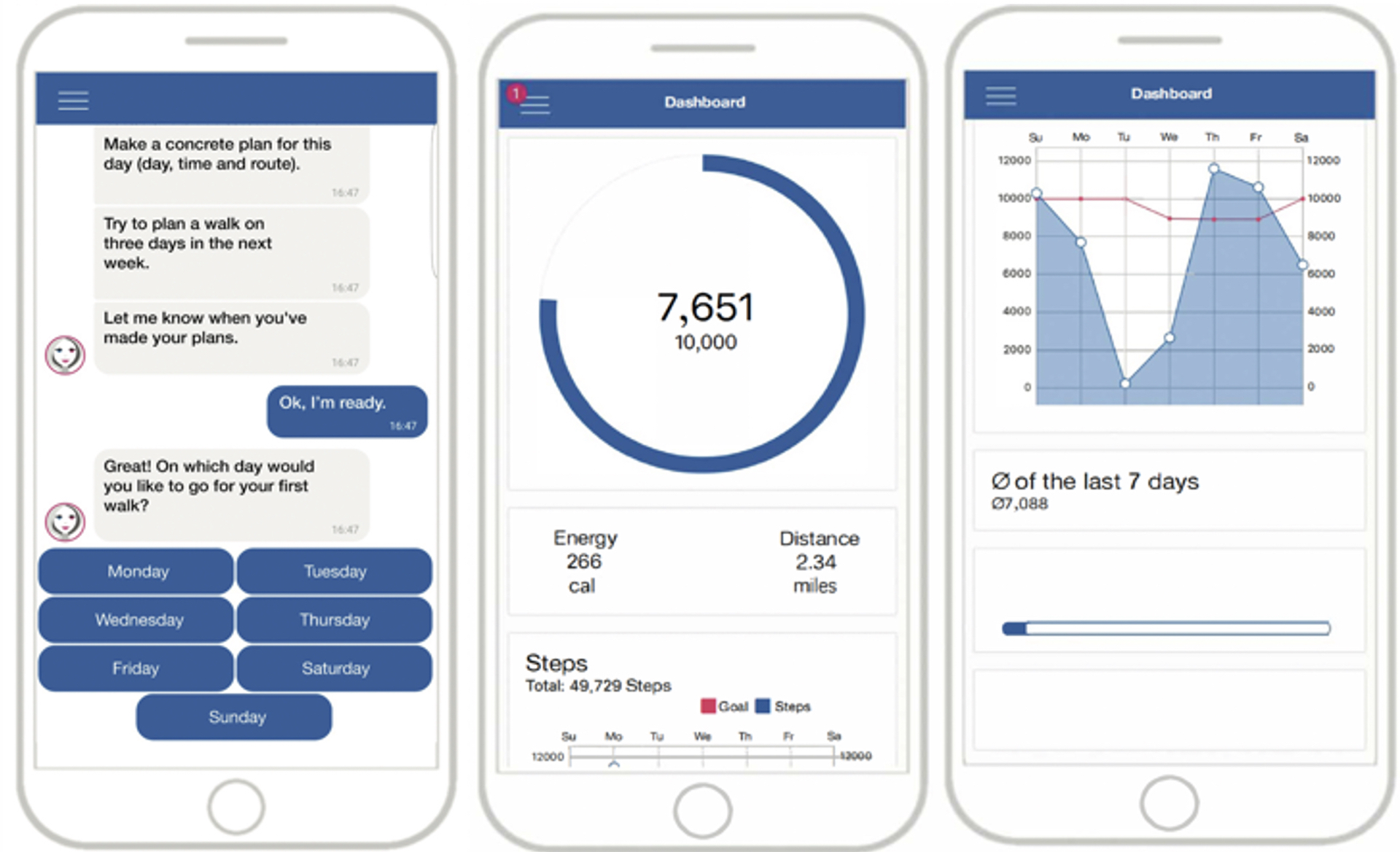
We have multiple projects currently underway to better evaluate the contexts where people are willing and able to engage with and use digital health interventions. These range from behavior-change interventions in free-living situations to interventions during specific scenarios, e.g., driving.
News
(October 2026) We are recruiting PhD students for Fall 2027
We are looking for highly motivated students interested in the intersection of Ubiquitous Computing and Health to join our lab in 2027, with a focus on Machine Learning for human behaviors.
continue reading...
(September 2026) Six papers accepted at IMWUT 2026
We have six new papers accepted at IMWUT, to be presented at UbiComp 2026 in Shanghai!
continue reading...
(September 2026) Tutorial at UbiComp 2026
Akshat Choube and Ha Le will be leading a hands-on tutorial at UbiComp/ISWC 2026 on building multi-agent AI systems for mobile and wearable sensing data.
continue reading...
(June 2026) Our lab attended the UbiComp + Health Symposium
Our lab attended the UbiComp + Health Symposium at NYU.
continue reading...
(April 2026) Ha receives the Apple AI/ML Fellowship
We are thrilled to announce that Ha has been named as a 2026 Apple AI/ML Scholar in Human-Centered AI!
continue reading...
(April 2026) Jiachen's paper receives CHI 2026 Best Paper Honorable Mention
We are excited to announce that Jiachen received the Best Paper Honorable Mention for her 2026 CHI Paper that she presented in Barcelona!
continue reading...
Recent Publications
Show all
MIND: Empowering Mental Health Clinicians with Multimodal Data Insights through a Narrative Dashboard
Ruishi Zou, Shiyu Xu, Margaret E Morris, Jihan Ryu, Timothy D. Becker, Nicholas Allen, Anne Marie Albano, Randy Auerbach, Dan Adler, Varun Mishra, Lace M. Padilla, Dakuo Wang, Ryan Sultan, Xuhai Xu
Proceedings of the 2026 CHI Conference on Human Factors in Computing Systems 2026
Show details
Ruishi Zou, Shiyu Xu, Margaret E Morris, Jihan Ryu, Timothy D. Becker, Nicholas Allen, Anne Marie Albano, Randy Auerbach, Dan Adler, Varun Mishra, Lace M. Padilla, Dakuo Wang, Ryan Sultan, Xuhai Xu
Proceedings of the 2026 CHI Conference on Human Factors in Computing Systems 2026
Exploring Collaboration Breakdowns Between Provider Teams and Patients in Post-Surgery Care
Bingsheng Yao, Menglin Zhao, Zhan Zhang, Pengqi Wang, Emma G Chester, Changchang Yin, Tianshi Li, Varun Mishra, Lace M. Padilla, Odysseas P Chatzipanagiotou, Timothy Pawlik, Ping Zhang, Weidan Cao, Dakuo Wang
Proceedings of the 2026 CHI Conference on Human Factors in Computing Systems 2026
Show details
Bingsheng Yao, Menglin Zhao, Zhan Zhang, Pengqi Wang, Emma G Chester, Changchang Yin, Tianshi Li, Varun Mishra, Lace M. Padilla, Odysseas P Chatzipanagiotou, Timothy Pawlik, Ping Zhang, Weidan Cao, Dakuo Wang
Proceedings of the 2026 CHI Conference on Human Factors in Computing Systems 2026
Evaluating Cross-Study Generalization of Receptivity Models for Just-in-Time Adaptive Interventions
Samarth Negi, Roman Keller, Jacqueline L. Mair, Birgit Kleim, Mathias Allemand, Florian von Wangenheim, Tobias Kowatsch, Varun Mishra
Proc. ACM Interact. Mob. Wearable Ubiquitous Technol. (IMWUT) 2026
Show details
Samarth Negi, Roman Keller, Jacqueline L. Mair, Birgit Kleim, Mathias Allemand, Florian von Wangenheim, Tobias Kowatsch, Varun Mishra
Proc. ACM Interact. Mob. Wearable Ubiquitous Technol. (IMWUT) 2026
Beyond the Binary: Operationalizing Receptivity to Digital Health Interventions as a Time-to-Event Spectrum
Samarth Negi, Varun Mishra, Chai Yin Kum, Oscar Castro, Tobias Kowatsch, Jacqueline L. Mair, Florian von Wangenheim
Proc. ACM Interact. Mob. Wearable Ubiquitous Technol. (IMWUT) 2026
Show details
Samarth Negi, Varun Mishra, Chai Yin Kum, Oscar Castro, Tobias Kowatsch, Jacqueline L. Mair, Florian von Wangenheim
Proc. ACM Interact. Mob. Wearable Ubiquitous Technol. (IMWUT) 2026
A Context-Aware Framework for Optimal Filter Parameter Selection: Enhancing PRV Estimation in Wearable Wrist PPG Signals
Yuna Naito, Natasha Yamane, Aarti Sathyanarayana, Matthew S. Goodwin, Varun Mishra
Proc. ACM Interact. Mob. Wearable Ubiquitous Technol. (IMWUT) 2026
Show details
Yuna Naito, Natasha Yamane, Aarti Sathyanarayana, Matthew S. Goodwin, Varun Mishra
Proc. ACM Interact. Mob. Wearable Ubiquitous Technol. (IMWUT) 2026